
Rush County VINELink Coverage
Kansas VINE is a free, confidential, voluntary notification service. The Kansas Attorney General describes it as a joint effort involving the Attorney General, the Kansas Department of Health and Environment, and the Kansas Sheriffs’ Association. Its public portal is Kansas VINELink. Web, telephone, email, text, TTY, and in-app access may be offered. Live help is available in many languages.
The key Rush County limit is the type of custodian. Kansas VINE covers offenders housed in county jails and expressly excludes Kansas Department of Corrections state-prison offenders. A record associated with Rush County Jail may be a proper VINE match if the county and record are participating at that time. Current participation should be checked on the live portal and the Attorney General’s coverage information before treating that route as available for a given person.
VINE also differs from the Sheriff’s operational file. Its task is to send notice when a participating jail reports a change. The Sheriff remains the custodian of the Rush booking and release or transfer record. Registration data is confidential within the service design, yet the notification itself should still be kept with the correct person and facility. A dated message is useful corroboration. It is not a substitute for the underlying government record when the exact release time, disposition, or receiving agency matters.
That boundary prevents a common false negative. A failed VINE search does not establish that a Kansas prisoner was released. The person may be in KDOC custody, the name may differ, participation or retention may affect the result, or the local event may not yet be reflected. Start with the agency that actually held the person.
Search Rush County VINELink
A specific-person search begins with the Kansas portal, not a general web search. Gather the person’s exact name, date of birth, and any known identifier or facility detail first. These facts help separate people with similar names. The goal is to match one county-custody record and then read its event wording without adding a legal conclusion.
- Open the Kansas VINELink portal and confirm Kansas is the selected state.
- Enter the exact name and any identifier the search accepts. Try a known alias or prior name if the first spelling fails.
- Open only a record tied to the expected county or facility. Do not assume the first name match is correct.
- Compare all displayed identity details and the facility before relying on the result.
- Read the current custody event literally. Release, Transfer, and Escape describe different events.
- Preserve the date and matched facility, then ask the Rush County Sheriff for the booking and release or transfer record when durable proof is needed.
A Transfer event means one custodian’s hold ended, but another may have begun. Escape is an unauthorized absence, not lawful release. A Release alert can show that VINE received a release event from the participating custodian; it does not prove dismissal, acquittal, time served, or full sentence completion. The Rush County released-inmate search path explains how the Sheriff record and court docket answer those separate questions.
There is no official Rush County web roster or release archive against which to compare the name. Online absence thus has little weight. Call the Sheriff with full name, birth date, and an approximate booking date when the live VINE match is missing or unclear.
Rush County VINE Release Fields
VINELink is built around custody status and notification. It is not a court docket or certified historical ledger. Fields can vary with the participating agency and current interface, so use only the facts actually displayed for the matched record. The most useful items are the identity details, facility, custody event, and event date or alert time.
| Field or event | What it can establish |
|---|---|
| Name and identifier | Helps distinguish the intended person from another person with a similar name. |
| County or facility | Shows which participating jail supplied the custody record. |
| Current custody status | Reports the status held by VINE at the time of access, subject to update lag. |
| Release | Signals a reported county-custody release event, which still needs Sheriff confirmation. |
| Transfer | Signals movement to another custodian, not a return to the community. |
| Escape | Signals unauthorized absence and must not be described as release. |
| Alert date or time | Dates the notification event, not necessarily a permanent release-record entry. |
The manifest’s successful capture comes from the live Kansas VINELink search.
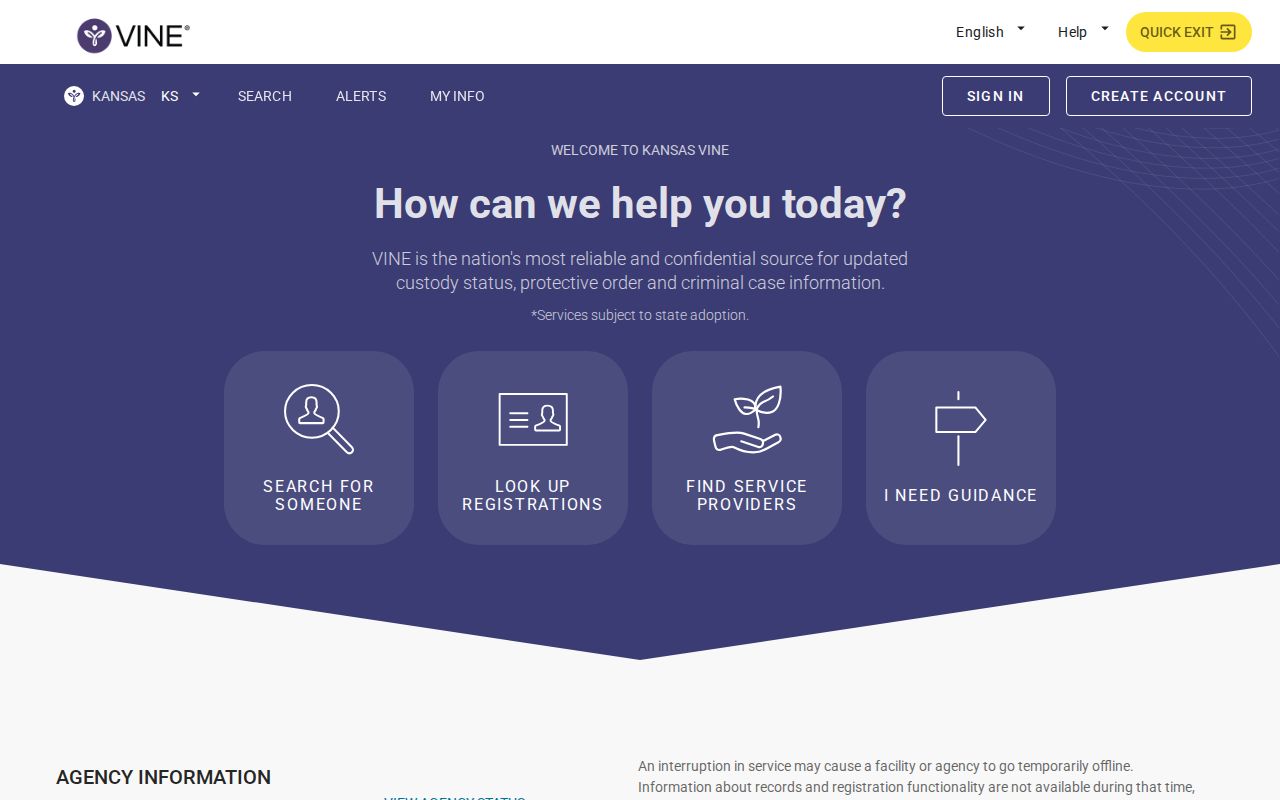
The screen is an entry point for a live check. A saved image records what appeared at access time, but custody data can change after capture.
Note: Keep the alert date, facility, and matched identity details together so the event cannot later be confused with another county record.
Register Rush County Release Alerts
Registration generally works best while the matching person remains in participating county custody. That timing matters. VINE is designed to send notice of a later change, not to serve as an unlimited after-the-fact archive. Choose channels that can be monitored and protect the registration data.
- Locate the correct in-custody person in Kansas VINELink and verify the county or facility.
- Choose the offered telephone, text, email, TTY, or app notification channel.
- Enter the contact details requested for each selected channel.
- For telephone alerts, create a four-digit PIN that can be recalled when a call arrives.
- Listen to the automated call, enter the PIN followed by the pound key, and acknowledge the notice. This stops repeated calls.
- For email, read and preserve the single custody-change message. The telephone PIN does not apply to email.
- Update or cancel registration through the service when contact details or notification needs change.
The official Kansas VINE brochure and a current state release support 1-866-574-8463. TTY service is 1-866-847-1298. An older static Attorney General page displays a number ending in 7463. Because the official sources conflict, the brochure-supported 8463 number is the safer published route, while users should still confirm current contact information through the live service.
Phone acknowledgment is often misunderstood. The PIN confirms receipt of the call and stops repeats. It does not prove identity, open a public record, or certify release. Text, email, TTY, and app channels have their own delivery behavior.
Rush County Release Routing
A Rush arrest can lead through more than one custodian. VINELink fits only one part of that chain. If Rush County Jail reports Release, preserve the alert and ask the Sheriff whether it was community release or transfer. If the Sheriff says KDOC received the person, move to KASPER. If a federal agency received the person, use that federal custodian’s record instead.
- County release
- A physical exit from Rush County Jail, confirmed by the Sheriff’s booking and release record.
- Transfer
- The end of Rush custody and the start of another agency’s custody.
- KDOC discharge
- The end of a Kansas state sentence or supervision, shown through KASPER or a KDOC record.
- Court disposition
- The legal result in the criminal case, which may explain but does not timestamp the jail exit.
These records can agree without being identical. A court may show bond posted before the jail finishes processing. VINE may then send a custody event. The Sheriff’s release time answers when the physical exit occurred. None of those facts alone proves that every other hold or legal duty ended.
Confirm Rush County VINE Releases
VINE notifications can lag behind a real event, and official materials do not promise a permanent Rush County released-person archive. A negative search may reflect spelling, participation, timing, or retention. It may also mean the person belongs in another system. No single missing result proves release.
For a Kansas state-prison case, search KASPER. It can show Inmate, parole or other supervision, and Discharged status for covered KDOC cases. For a federal sentence, use the BOP Inmate Locator, not VINE. A BOP result may show a past, future, or unknown release date. Immigration custody uses ICE’s locator and has its own limits.
When VINE reports Release, note the matched facility and alert time. Then ask the Sheriff whether the disposition was release to the community or movement to another custodian. Obtain the existing booking and release record if a dated record is needed. If the VINE message and Sheriff record conflict, preserve both and ask whether an update delay or transfer code explains the difference.
A narrow records request works better than a broad demand. Identify the person, approximate booking period, and Rush County Jail as the custodian. Ask for existing records sufficient to show the booking date and time, actual release or transfer date and time, disposition, and receiving agency when applicable. This wording seeks records the office may already keep. It does not ask staff to build a custom report or decide what a VINE event meant.
The District Court is a second check when the legal reason matters. Its docket may show bond, dismissal, sentence, probation, or commitment. The docket time and the jail exit time need not match because they describe different acts. A court order can authorize release while another hold remains. For that reason, pair the court event with the Sheriff’s custody record and keep the VINE alert as dated notice of the reported change.
Note: VINE does not establish dismissal, acquittal, sentence completion, or freedom from another agency’s custody or supervision.