
Rush Projected Versus Actual Release
A projected date is a calculation based on the sentence data and credits known at that point. It is prospective. An actual release date records an event that already occurred. Kansas Department of Corrections materials call the projection an “Anticipated release date,” while the live KASPER record has used “Earliest Possible Release Date.” Both labels describe a forecast, not a dated discharge record.
A pretrial Rush County detainee often has no computed sentence end date. Bond may be posted, a judge may enter an order, or a charge may later be dismissed, yet the jail still must process the order and resolve any other hold. The Rush County Sheriff confirms physical release or transfer. The District Court record explains the legal event. Neither source publishes a standard local processing time.
A sentenced KDOC resident is different. KASPER can display a state-sentence projection, and the status may remain Inmate until the person physically leaves prison. Later, Parole or postrelease supervision can show physical release with legal supervision still active. Discharged means the covered KDOC sentence and supervision ended. The Discharged Date is historical evidence, not another name for the earlier projected date.
Find Rush County Projected Release
Start with custody type. KASPER is broad, but it is not the right first source for every Rush County booking. A person who posted bond or served a local jail sentence may never receive a KDOC number. State-sentence projections belong to KDOC. County calculations belong to the local sentence, court papers, jail credit, and Sheriff or jail record.
- Determine whether the person is awaiting trial, serving a Rush County jail sentence, or serving a KDOC state sentence.
- For KDOC custody, open KASPER, accept the disclaimer, and search by name or KDOC number.
- Use aliases, conviction county, or supervision county to narrow results when needed. Rush as conviction county does not prove a planned return to Rush County.
- Open the matching record and compare birth date, physical details, photograph, KDOC number, case data, and movements.
- Read Current Status before the date field. Then record any Anticipated Release Date or Earliest Possible Release Date exactly as labeled.
- For a Rush County jail sentence, obtain the sentencing journal entry, jail-credit calculation, and Sheriff or jail computation instead of applying a KDOC formula.
- For a person-specific state calculation, contact KDOC Sentence Computation at 785-296-3317.
The Rush County release-record search gives the broader path for a booking, court disposition, transfer, or completed release. A projection should stay attached to its case and custodian. An old KASPER discharge from another sentence cannot answer the status of a new Rush arrest.
The official KDOC locating explanation describes KASPER coverage and fields.

The field guide helps interpret the repository, but only the live, matched KASPER record can show the current value for a covered person.
Rush KASPER Release-Date Labels
Two official labels appear in the research. KDOC’s agency explainer uses “Anticipated release date.” The live offender detail has used “Earliest Possible Release Date.” Preserve the label found on the current record when documenting a result. Do not silently change it to “confirmed release date,” because that would turn a forecast into a fact that the field does not establish.
| KASPER item | How to read it |
|---|---|
| Current Status: Inmate | The person remains incarcerated as of the repository update. |
| Earliest Possible Release Date | A prospective state-sentence calculation that may change. |
| Parole or postrelease | The person has physically left prison but remains under KDOC supervision. |
| Discharged Date | A historical date showing the covered sentence and supervision ended. |
| Movement | A custody or placement change that may be a transfer rather than release. |
KASPER updates on working days, described as daily excluding weekends. A real event can occur before the public record changes. Capture the access date with the result. Then recheck after the expected date for a movement, supervision status, or later discharge entry.
Note: A Rush conviction county identifies the case source, not the person’s intended post-release home or supervision office.
Kansas Credit Rules for Rush Releases
Kansas is not a flat “serve 85%” system. Under K.S.A. 21-6821, the maximum good-time credit is 15% for many crimes committed on or after July 1, 1993. That cap creates the familiar 85% shorthand only when the statute applies and all available credit is retained. It should not be stated as a rule for every Kansas sentence.
The statute provides a 20% cap for specified lower-severity nondrug crimes committed on or after January 1, 2008 and for specified lower-severity drug crimes within the law’s date bands. It also permits up to 120 days of program credit for eligible sentences and program completions, subject to exclusions. Good-time credit and program credit are related inputs, not the same award.
Credit can be earned, withheld, or forfeited. Offense date, severity, sentence type, statutory exclusion, and program eligibility all matter. Older indeterminate and off-grid sentences follow other eligibility rules. K.S.A. 22-3725 supplies an older-law table; it is not authority for applying the modern 85% shorthand to every case.
For a modern determinate guidelines sentence, the prison term is set by the sentence and release to mandatory postrelease generally follows the maximum prison term less retained credit. K.S.A. 22-3717 supplies postrelease terms and exceptions. This framework differs from a discretionary parole decision. It also differs from an older indeterminate sentence, where a minimum term and parole eligibility can control when review becomes possible. Reading the offense date and sentence type is therefore as important as reading the percentage.
The source image below comes from the official Kansas good-time and program-credit statute.
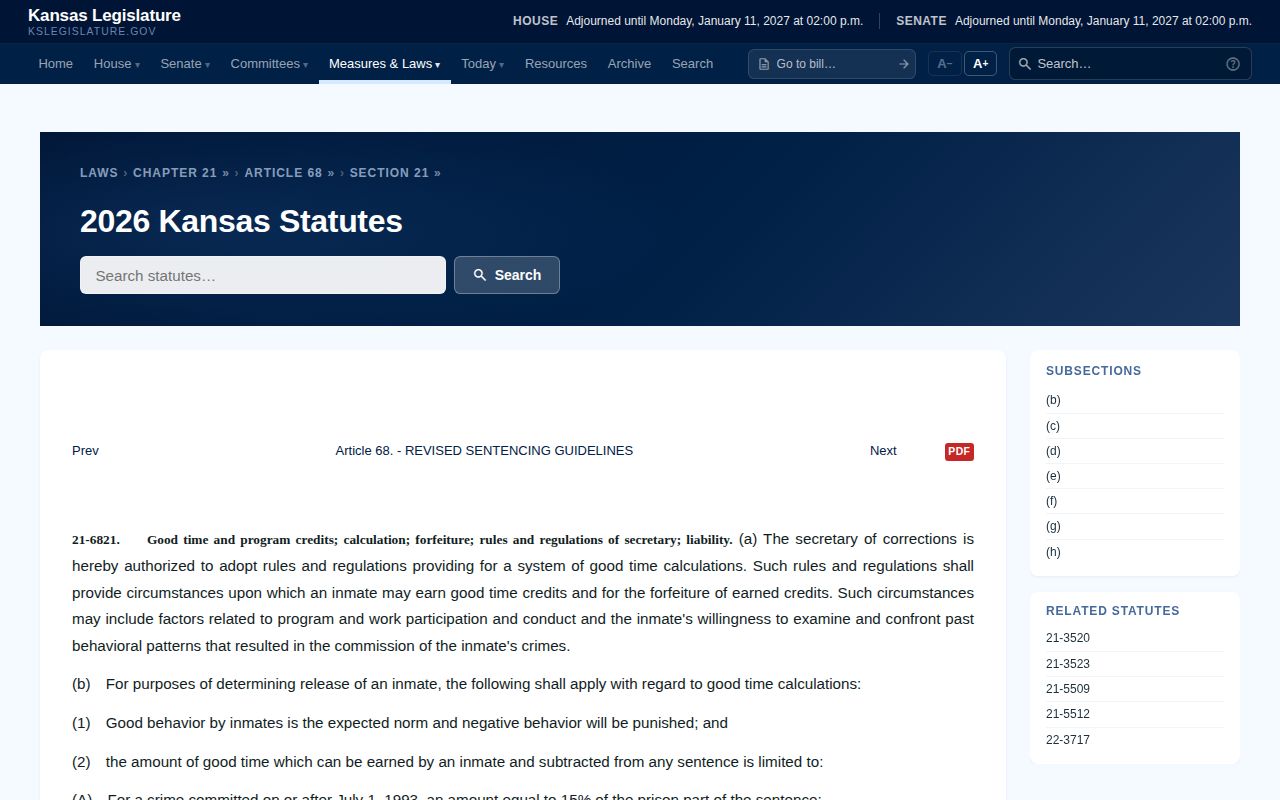
The statute shows why the exact offense, date band, severity, and eligibility must be known before a projected date can be interpreted.
Why Rush Release Dates Move
A state projected date is the result of several inputs. Change one input and the display may move. KDOC warns that release dates depend on earned and forfeited good time and program credits. The research also identifies sentence structure, jail credit, discipline, statutory limits, court action, and correction of record data as possible causes.
| Factor | Possible effect on the date |
|---|---|
| Earned good time | Retained credit can move the projected end earlier within the controlling law. |
| Withheld or forfeited credit | Discipline or loss of credit can move the projection later. |
| Program credit | An eligible completion may reduce time, subject to statutory limits and exclusions. |
| Jail credit | Credit for qualifying prior custody changes the remaining sentence calculation. |
| Multiple sentences | Consecutive or concurrent treatment changes the aggregate computation. |
| Court amendment | A corrected or changed sentence order can require recalculation. |
| Detainer or hold | The person may leave one custodian yet remain confined under another authority. |
Parole also requires precise language. For many determinate Kansas Sentencing Guidelines cases, release to mandatory postrelease follows the prison term less retained credit. Older indeterminate and off-grid cases may use different parole eligibility rules. A Prisoner Review Board calendar can show a possible later release month, but it is not a promise. “Pass” is denial, “Continue” defers a decision, and “Parole” is authorization subject to processing and conditions.
Rush County Jail Date Computation
KDOC’s state-prison credit formula must not be copied onto an ordinary Rush County jail sentence. The local calculation needs the sentencing journal entry, the jail-credit calculation, and the Sheriff or jail computation. Rush County publishes no local good-time policy, weekend-release rule, release hour, or processing-time standard.
For a pretrial case, ask the District Court whether an order was entered and transmitted. Then ask the Sheriff whether another hold or receiving authority blocks community release. A bond order may authorize release while physical processing remains unfinished. If another county, KDOC, ICE, USMS, or an out-of-state authority receives the person, Rush custody may close as a transfer even though confinement continues.
- Journal entry
- The court’s written sentence or order, used to identify the legal terms.
- Jail credit
- Qualifying time already spent in custody and applied to the sentence.
- Detainer
- Another agency’s request or authority that can prevent community release.
- Postrelease supervision
- Required community supervision after the prison portion ends.
When records disagree, keep the custodians separate. The court explains its order. The Sheriff confirms the Rush jail exit or transfer. KDOC explains a state calculation. Asking one office to certify another office’s event can produce an incomplete answer.
Confirm Rush County Release Dates
On or after the anticipated day, check the source that owns the sentence. For a KDOC resident, recheck KASPER after its working-day update and compare Current Status, movements, supervision type, and any discharge field. A future date that remains beside Inmate status still describes a projection. Questions about the individual math belong to KDOC Sentence Computation at 785-296-3317.
For a Rush County sentence or booking, call the Rush County Sheriff and request the actual release or transfer record. Give a full name, birth date, approximate booking date, and case or booking number if known. The record should distinguish community release from transfer. The court docket can then explain bond, dismissal, sentence, probation, commitment, or another legal event.
VINE does not cover KDOC state-prison offenders, so a Kansas prison release should not be monitored there. The Rush County VINELink check applies to participating county-jail custody and can send a custody-change alert when registration occurs in time. A VINE Release notice still needs the Sheriff record for durable local proof.
For a KASPER accuracy issue, send written comments to kdoc_pub@ks.gov. Include the disputed field and enough record detail to identify it. Computation questions go to Sentence Computation, while a changed judicial sentence may require the court process. Each custodian can correct only its own record.
Note: A person can be discharged from an older KDOC case while held on a newer Rush County matter; match dates and case numbers.