
Rush County Release Records
“Released” describes the end of one agency’s custody, but it does not always mean return to the community. A person may leave Rush County Jail after bond, a court order, dismissal, time served, or an order of probation. The same booking may close because another county, the Kansas Department of Corrections, the United States Marshals Service, or immigration officers took custody. That last event is a transfer. The person remains confined even though the Rush County stay ended.
Three records answer three different questions. The Sheriff’s booking and release record shows whether physical custody ended, when it ended, and whether another agency received the person. A Rush County District Court file explains the legal event, such as bond, dismissal, sentence, probation, or commitment. KASPER, the state corrections repository, shows a Kansas prison sentence or post-prison supervision. None should be used as a substitute for the others.
Release terms
Bond permits release while a case continues. Time served credits or completes the custodial part of a sentence. Probation is a court-ordered community sentence. Parole is supervised release from prison. Discharge means a sentence or supervision term has ended.
Rush County Custody Outcomes
The recorded disposition determines the next useful source. Bond and dismissal point toward the county case and Sheriff record. Probation calls for the court order and the supervising office. A KDOC commitment moves the search to KASPER. Transfer language requires the receiving agency’s own locator or records office.
| Outcome | Meaning | Best next record |
|---|---|---|
| Bond or court order | County custody may end while the case remains open. | Sheriff release record and District Court docket |
| Time served | The credited jail term has been completed. | Release timestamp and sentencing entry |
| Probation | The person serves a court sentence in the community under conditions. | Court order and 24th Judicial District supervision office |
| KDOC commitment | County custody ends and state custody begins. | Sheriff transfer entry, then KASPER |
| Federal or ICE transfer | Another custodian receives the person. | Sheriff destination field, then the federal or ICE system |
A court order can authorize release before jail staff complete it. Staff may still need to verify the order or resolve another hold. No official Rush County source states a standard processing time, release door, or weekend schedule. Confirm the physical exit with the Sheriff rather than treating an order time as the jail-door time.
Fields in Rush County Releases
Rush County does not publish a local field dictionary or online release screen. The items below are precise request descriptions, not claims about the Sheriff’s database labels. Ask for an existing record tied to one booking. That wording helps the custodian locate a record without having to create a new report.
| Requested field | What it can establish |
|---|---|
| Name, birth date, booking number | The identity and exact custody event |
| Arrest and booking date or time | When the Rush County stay began |
| Charge, bond, court or case number | The booking’s link to the legal case |
| Actual release date and time | When Rush County physical custody ended |
| Releasing authority and disposition | Whether bond, time served, dismissal, probation, or another order caused release |
| Receiving agency or facility | Whether the event was a transfer instead of community release |
| Associated booking photograph | The image attached to that booking, if open and retained |
Pair the jail record with the court docket when the reason matters. A bond entry does not mean acquittal. A dismissal entry describes the case but does not prove the minute when jail staff finished release. Likewise, a transfer to KDOC closes local custody while state confinement continues.
Request Rush County Release Records
The Rush County Sheriff publishes no dedicated KORA form, fee schedule, release archive, or retention rule online. Contact the office at 715 Elm Street, PO Box 495, La Crosse, Kansas 67548, call 785-222-2578, or email sheriff@rushcountykansas.gov. Ask first whether the person was released or transferred. A written request creates the clearest record when documentation is needed.
- Identify the person by full name, date of birth, and any known booking or case number.
- Give a narrow arrest, booking, or release date range.
- Request existing records showing actual release date and time, disposition, and receiving agency if transferred.
- Ask for electronic copies or inspection and a cost estimate before copies are made.
- If material is withheld, ask for the legal basis and any nonexempt portions that can be separated.
Kansas law allows reasonable copy and staff-time charges. The fee may be required in advance, but Rush County has not posted a fixed local amount. An agency must act on a request as soon as possible and, if it cannot grant access within three business days, provide a detailed explanation of the cause and the earliest expected availability. That is a response rule, not a promise that every record will arrive within three days.
Kansas Law on Rush Releases
K.S.A. 22-4705 expressly lists release from detention or confinement as a reportable criminal-history event. That supports treating release as a formal event instead of an inference from a missing name. It does not create a free Rush County release portal.
K.S.A. 45-218 governs inspection and the three-business-day response rule, while K.S.A. 45-219 addresses reasonable copy and staff charges.
Access is not absolute. Sealed or expunged material, juvenile matters, and exempt investigative information may be restricted. Kansas expungement periods vary by offense and case history. A granted order generally limits public court disclosure, but it does not promise that copies lawfully obtained earlier vanish. Rush has no published county release-record retention schedule, so do not apply KDOC’s state inmate-file rules to Sheriff files.
Find Released Rush County Inmates
Begin with the custodian, not a broad statewide name search. Rush County has no public jail roster or recent-release feed. Direct Sheriff confirmation is therefore the first local step, not merely a fallback. Use a birth date and an approximate booking date to separate people with similar names.
- Ask the Rush County Sheriff whether the booking ended in release or transfer, with the actual date, time, disposition, and destination.
- Search the Rush County criminal case for bond, dismissal, sentence, probation, commitment, revocation, or discharge entries.
- Use KASPER only when KDOC custody or supervision is involved. Compare identity, case, status, movements, and dates.
- Check Kansas VINELink for a county-jail custody event or alert, while remembering it is not a promised permanent archive.
- Use BOP or ICE tools only for the matching federal or immigration custodian.
- Request the originating agency’s record when an online result is absent, unclear, or inconsistent.
A released person normally leaves a live roster, but Rush County publishes no roster. Online absence alone has no evidentiary value.
No single negative result proves release. A person who posted bond on a local case may never have a KDOC number. A missing KASPER probation event may reflect the known community-corrections display gap. A VINE record may no longer be visible after the custody event. Resolve a conflict with the agency that held the person.
KDOC Search for Rush Releases
KASPER covers people sentenced to the Secretary of Corrections from 1980 forward who are incarcerated, under post-prison supervision, or discharged. It is the right statewide source for a KDOC case. It is not the primary record of an ordinary Rush County Jail bond release or short local sentence.
| Search or result field | How to use it |
|---|---|
| Name, alias, KDOC or KBI number | Find and distinguish a likely person |
| Birth date, physical details, photo | Confirm identity before relying on status |
| Conviction county | Narrow to Rush cases without assuming current residence |
| Supervision type | Distinguish Inmate, Parole, Community Corr., or Discharged |
| Movements and facility | Separate transfer from physical release |
| Discharged Date | Document the end of the KDOC sentence or supervision |
The live detail may also show an Earliest Possible Release Date. That is prospective and can change; it does not confirm release. KASPER updates on working days, so a real custody change can appear before the public display catches up. A status of Parole or postrelease supervision means prison custody ended but KDOC control continues. Discharged means the KDOC term ended, though another case or jurisdiction may still exist.
The live search screen shows the available search fields:
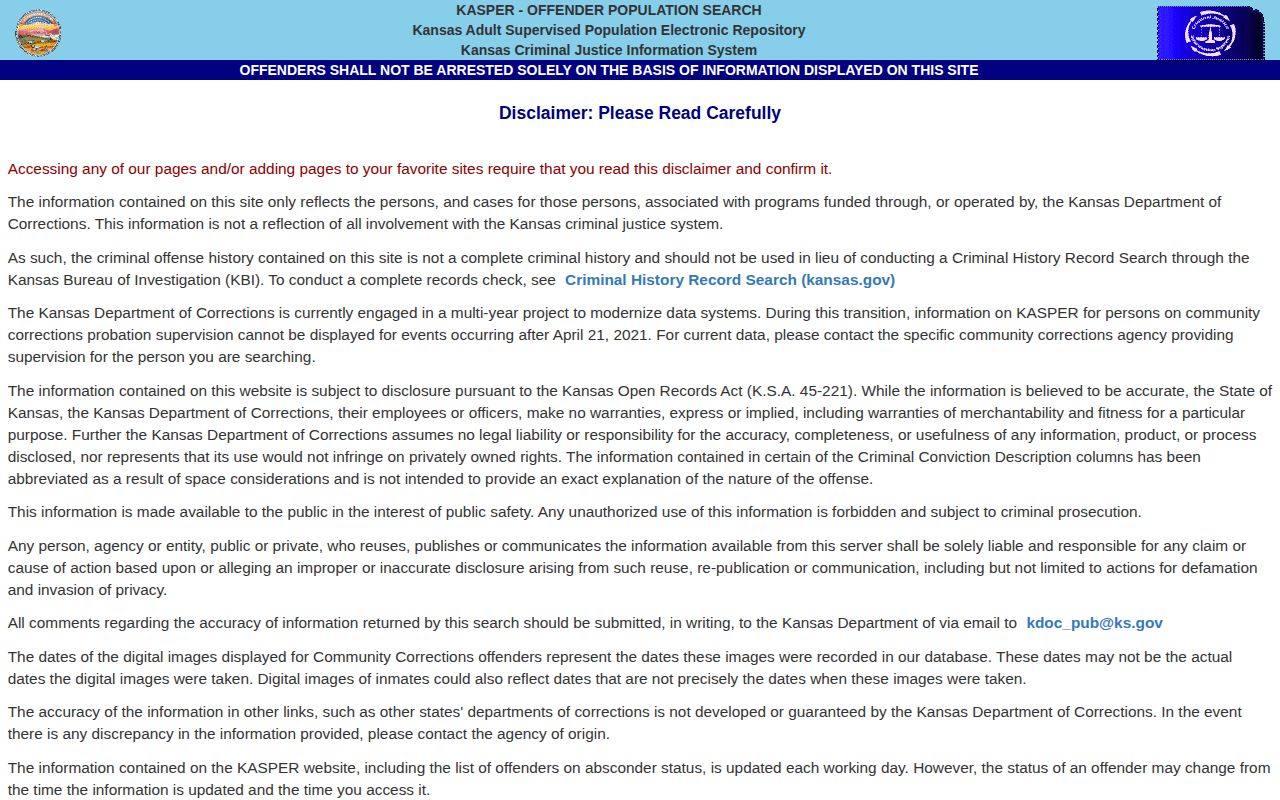
The screen helps narrow a state record by identity, conviction county, supervision county, and status rather than relying on a name alone.
No Rush County Release Feed
The official Sheriff site has no current-inmate roster, booking-detail page, 24-hour list, 72-hour list, or release archive. It publishes no feed fields, update schedule, online retention window, or photo function. The practical route is a direct custody check followed by a narrow KORA request for an existing log or booking record.
Rush County adopted the generic Sheriff Connect app in 2025. Users must search inside that app for the Rush County Sheriff’s Office. Its store description advertises jail information in general, but no official source confirms that Rush has enabled inmate, release, or photo functions. A similarly named standalone app belongs to Rush County, Indiana and must not be used for Kansas records. Social posts and local news may report incidents, but neither is an official rolling release list.
Rush County Supervision After Release
Two offices serve different roles. KDOC parole, conditional release, and postrelease supervision for Rush County route through the Great Bend Parole Office. Court probation and community corrections route through the 24th Judicial District office in Ness City. Search KASPER for current status and office, then call the correct office because recent community-corrections probation events may be missing during system modernization.
An absconder entry alleges lost contact during active supervision. It is not discharge, and the display alone is not authority for an arrest. A violation may lead to revocation and renewed custody. The Rush County parole and probation page separates these offices, searches, and status terms.
Rush Release Alerts and Federal Records
Kansas VINE covers county-jail custody and expressly excludes KDOC prisons. Search a matching Rush County jail record, compare identifiers, and read the event exactly. Release, Transfer, and Escape do not mean the same thing. A dated alert can help establish when a change was reported, but the Sheriff record remains the durable source. Register while the person is in custody for telephone, text, email, TTY, or app notices that the service offers.
Federal custody uses separate paths. The BOP Inmate Locator covers federal records from 1982 forward and may show a past Release Date with Released or Not in BOP Custody. That confirms the end of BOP custody, not the end of federal supervised release or custody elsewhere. ICE’s locator covers current detainees and people released from ICE custody for only 60 days. United States Marshals pretrial custody may require the federal case or direct agency contact because a person may not appear promptly in BOP.
Match Rush Release to Custodian
The same person can have a historical KDOC discharge and a new Rush County arrest. Match each result to its case, date, and custodian. One status badge cannot describe every justice event.
| Situation | Where to look | What confirms release |
|---|---|---|
| Rush County Jail | Sheriff and District Court | Actual Sheriff exit or transfer plus the legal order |
| Kansas prison | KASPER | Movement or supervision status; Discharged Date for sentence completion |
| County notification | Kansas VINELink | Dated event, verified with the Sheriff |
| Federal prison | BOP Inmate Locator | Past Release Date and released custody status |
| Immigration custody | ICE ODLS | Locator result within its limited post-release window |
Rush County Detention Facility
Rush County Jail is the only adult detention facility found in the official county sweep. The Sheriff operates it, not KDOC. A person may leave for the community or transfer to another custodian. The Sheriff record supplies the actual route. No official source identified a separate city jail, state prison, federal prison, or ICE detention center inside Rush County.
Rides After Rush County Release
Rush County Public Transportation is a real local ride option, but it is not a dedicated jail pickup service. The published service runs Monday through Friday from 7:30 a.m. to 4 p.m., is first come and first served, and does not run during evenings, weekends, courthouse holidays, or unsafe road conditions. A person leaving after hours cannot assume a ride will be waiting.
The county transportation page lists current hours, local fares, and the number 785-222-3537.
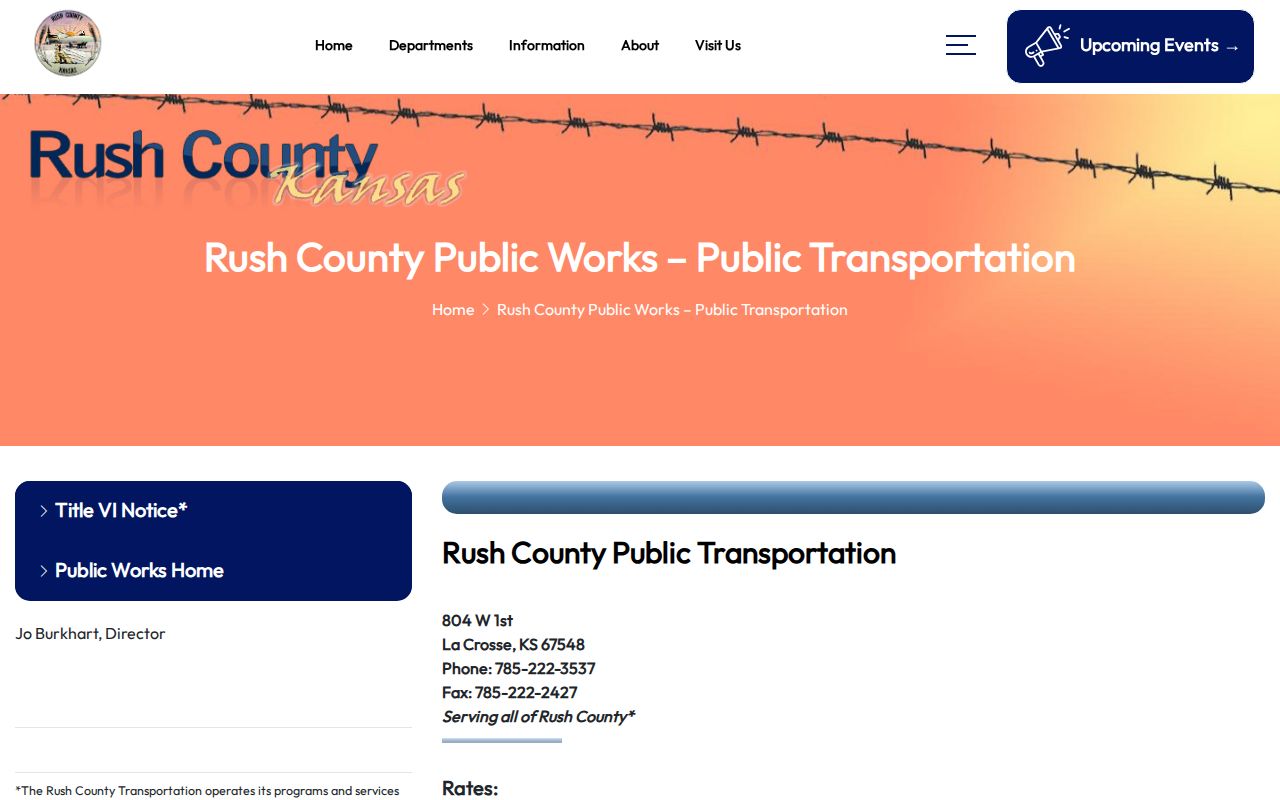
The schedule shows why transportation should be arranged before release whenever the likely timing is known.
Two Rush County Release Records
The Sheriff record and District Court file answer different parts of the same question. The Sheriff confirms the end of physical custody and any transfer destination. The docket explains whether bond, dismissal, sentence, probation, or commitment supplied the legal basis. Since Rush County has no online release archive, the two-record method is essential.
The official District Court page provides the local court contact.
Use the court case to explain the order, then return to the Sheriff for the actual exit time.
Rush Release Is a Record Event
Kansas law makes release from detention or confinement a reportable criminal-history event. This matters in a county without a public roster: release should be confirmed from the event record, not guessed from online silence. The central criminal-history repository does not function as a free Rush County recent-release list, so the Sheriff and court routes still control public verification.
Is Rush County Jail Closed?
The county courthouse history says the Sheriff’s office occupies a brick-and-stone building that once was the jail. A newer official KDOC county-jail directory still lists Rush County Jail at the same address. The historic wording is not proof that the current officially listed jail is closed. Capacity, cell arrangement, release exit, and routine release schedule remain unpublished.
Rush Release to ICE
A Rush County booking that closes with an ICE handoff is a transfer between custodians, not return to the community. First obtain the Sheriff’s destination entry. Then check the ICE Online Detainee Locator System with the person’s A-number and country of birth or exact biographical details. Allow for processing lag.
ICE retains released-from-ICE locator results for only 60 days. After that window, a missing name is expected and proves no particular immigration result. The Sheriff transfer record and later ICE status form a chain; neither alone explains the final immigration case outcome.