
Rush County Three-Day Release Window
The official Rush County website has no jail roster and no rolling 72-hour release view. It also publishes no booking page, field guide, update cadence, archive length, or release photograph setting. That absence changes the task. There is no page to sort by date and no web name whose disappearance proves a person left Rush County Jail.
A three-day search should therefore define its dates precisely. Ask the Sheriff whether an existing release log covers that bounded span. If the concern is one person, provide the full name, date of birth, approximate booking date, and the beginning and end of the 72-hour period. Request the actual release time, disposition, and receiving agency. That last field shows whether the person returned to the community or went into another agency’s custody.
The Rush County Sheriff contact page is the official local starting point shown below.
Its lack of a public roster means a direct records inquiry is the real three-day lookup method.
Request Rush County 72-Hour Releases
A request for existing records is stronger than asking the Sheriff to research and write a new answer. It should name a narrow time range and the fields needed. If the agency keeps a release log, ask for that existing log. If no such list is maintained, narrow the request to the identified booking record. Rush County publishes no Sheriff-specific KORA form, fee list, office hours, or promised turnaround.
- Write down the exact start and end of the three-day period. State the time zone if the boundary may be disputed.
- Call 785-222-2578 and ask whether an existing Rush County Jail release log covers those dates.
- For one person, give the full name, birth date, and approximate booking date. Ask for release or transfer status.
- Request actual release date and time, disposition, releasing authority, and any receiving agency or facility.
- Ask for electronic delivery, segregable open portions, the legal ground for any withholding, and a cost estimate before work begins.
- Use the Kansas district-court records system to find the related bond, sentence, dismissal, probation, or commitment entry.
Kansas law permits written requests and actual-cost fees. The Sheriff can require advance payment and does not have to create a custom list that does not exist. If the request is delayed, the response should give the cause and earliest availability. The three-business-day rule requires agency action, not guaranteed production of every record within three days.
If a response contains both open and exempt material, ask for the segregable portions that can be released. A denial should cite the statutory ground. If the Sheriff is not the custodian of a requested record, Kansas law provides a route for identifying the custodian when that office is readily known. Preserve the request and reply so the date range, wording, and any stated limits remain clear.
Note: Keep the response date because a later correction may change the release time, disposition, or receiving agency.
Rush County 72-Hour Record Fields
No public feed fields are documented. The entries below are request terms drawn from the Rush County records research, not a claim about the names of columns in Sheriff software. They keep a three-day request tied to a real custody event and help prevent one booking from being confused with another.
| Field to request | Why it matters across three days |
|---|---|
| Full name and date of birth | Separates people with similar names. |
| Booking number and booking time | Ties the result to the correct jail stay. |
| Actual release date and time | Places the event inside or outside the bounded window. |
| Release disposition or authority | Identifies the stated basis for the end of Rush custody. |
| Receiving agency or facility | Distinguishes community release from a continued-custody transfer. |
| Court or case number | Connects the custody event to the legal docket. |
The release record answers when physical custody ended. The court record answers why the legal status changed. A bond order does not itself prove the person walked out at that moment because another hold may remain. Likewise, a Sheriff transfer entry does not mean the person became free.
KORA for Rush County Releases
K.S.A. 45-218 governs inspection, agency action, delay explanations, and denial citations under the Kansas Open Records Act. K.S.A. 45-219 permits copies, written requests, advance payment, and fees based on actual cost. A useful request asks for “existing records sufficient to show” the relevant release events. That wording avoids demanding a new report when Rush County has no published three-day list.
Send a Rush County Jail request to the Sheriff at 715 Elm Street, PO Box 495, La Crosse, KS 67548. The published telephone is 785-222-2578, fax is 785-222-3328, and email is sheriff@rushcountykansas.gov. Ask whether the office accepts the request by email and call before an in-person visit because records hours are not published.
The official K.S.A. 45-218 text is the source captured here.
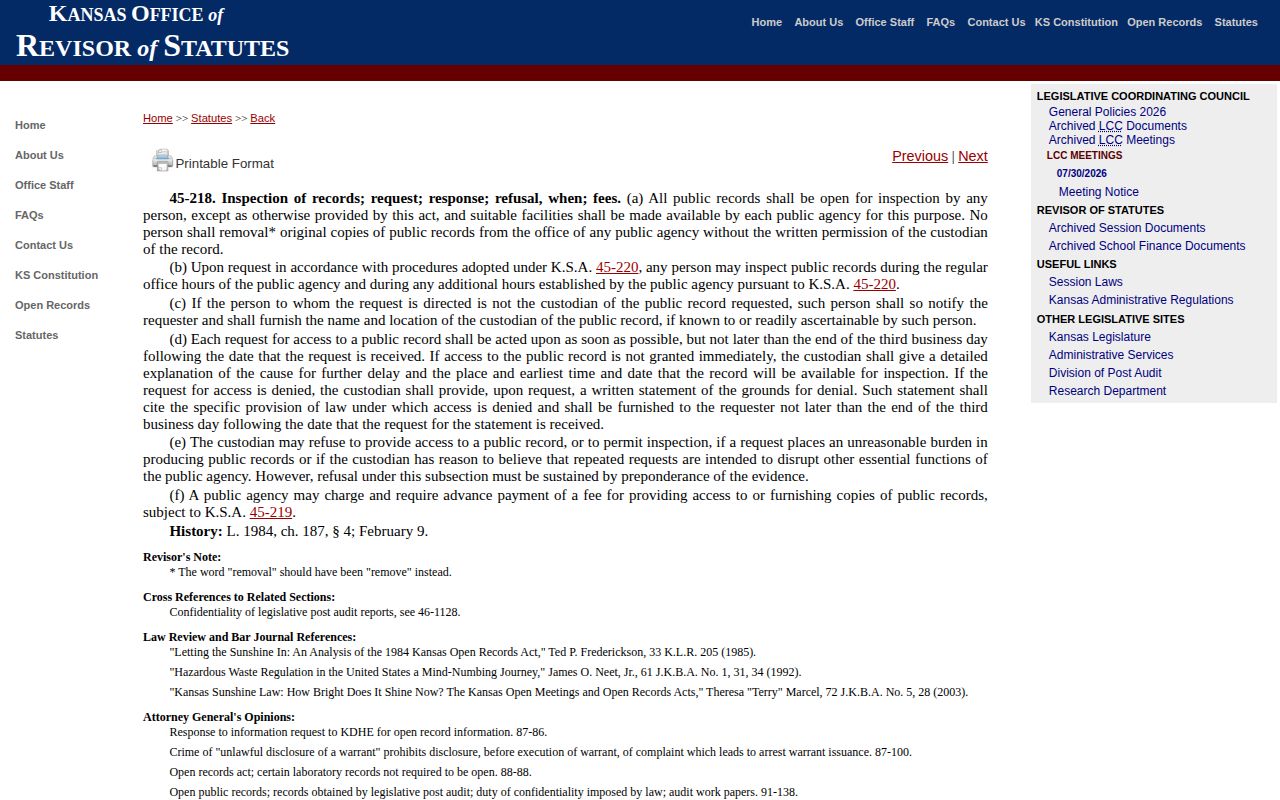
The statute supports a focused request and a documented response path, but it does not create a Rush County online release feed.
Rush County Weekend Release Checks
A 72-hour span can bridge Friday, Saturday, and Sunday, which makes it more useful than a same-day query when the exact release date is unknown. Yet no official source established a Rush County weekend or holiday release practice. No fixed processing hour, exit point, property procedure, or delay rule was found. Do not assume that a court date, bond posting time, VINE alert, or office reopening time is the actual physical exit time.
KASPER adds another timing limit for people entering KDOC custody. It updates each working day and excludes weekends, so a state movement can occur before the public record changes. That does not turn KASPER into a county release list. Use it only when the person entered Kansas Department of Corrections custody or supervision. For an ordinary Rush County Jail event, the Sheriff remains the originating custodian.
A court holiday may also affect access to a filing without changing the real custody event. The courthouse docket can later explain bond, dismissal, sentence, probation, or commitment, but the Sheriff’s timestamp is needed when the exact exit matters. A wider window helps gather the events. It does not remove the need to compare sources.
Verify Rush County Release Status
Use each system only for the custody it covers. Kansas VINE is designed for alerts tied to participating county-jail custody. A person generally must be found and registered while still held. Preserve a dated alert, compare the identity and facility, and then request the Sheriff record. VINE does not promise a permanent historical ledger, and its event words must be read exactly.
| Situation | Best source | Key limit |
|---|---|---|
| Rush jail release | Sheriff booking/release record | No public online roster or archive |
| Bond, sentence, or dismissal | Rush County District Court record | May not show the exact physical exit |
| County custody alert | Kansas VINELink | Notification tool, not a certified archive |
| KDOC release or discharge | KASPER | Not for routine county-only bookings |
| Federal prison release | BOP Inmate Locator | Does not rule out other custody or supervision |
| Transfer to ICE | Sheriff record and ICE locator | A transfer is not community release |
For a narrow same-day check, the Rush County 24-Hour Release List gives the named-person call and alert workflow. Use the three-day method when the date is uncertain or the requested period crosses a weekend.
No Rush County Roster Test
The distinctive local rule is simple: absence from the official county website cannot prove release because Rush County has no public roster from which a name could disappear. The meaningful route is direct Sheriff confirmation, a narrow KORA request, and court or VINE corroboration. This differs from counties that maintain a sortable released-person archive.
A negative search elsewhere also needs context. KASPER may omit a person who never entered KDOC, was searched under another name, or falls within an excluded category. VINELink may be affected by timing, spelling, participation, or retention. A court document may be public but available only at a courthouse terminal. Resolve conflicts with the agency that held the person, and preserve the date of every result.
An old KASPER discharge and a new Rush County booking can both be correct. The discharge may describe the end of an earlier state sentence, while the Sheriff record describes a later local case. Match case numbers, conviction county, booking dates, and movement dates before combining results. A three-day lookup is event-specific, not a statement about every prior or later custody record tied to the same name.
- Release
- Rush County custody ended and the person may have returned to the community under lawful authority.
- Transfer
- Rush County custody ended while another local, state, federal, or immigration custodian took control.
- Disposition
- The legal result or action, such as bond, dismissal, sentence, or probation.
- Discharge
- The end of a sentence or supervision term, which can occur after physical release.
Note: A missing online result is a search outcome, not proof that no release or transfer event occurred.
Public Record Search
Sponsored Results